

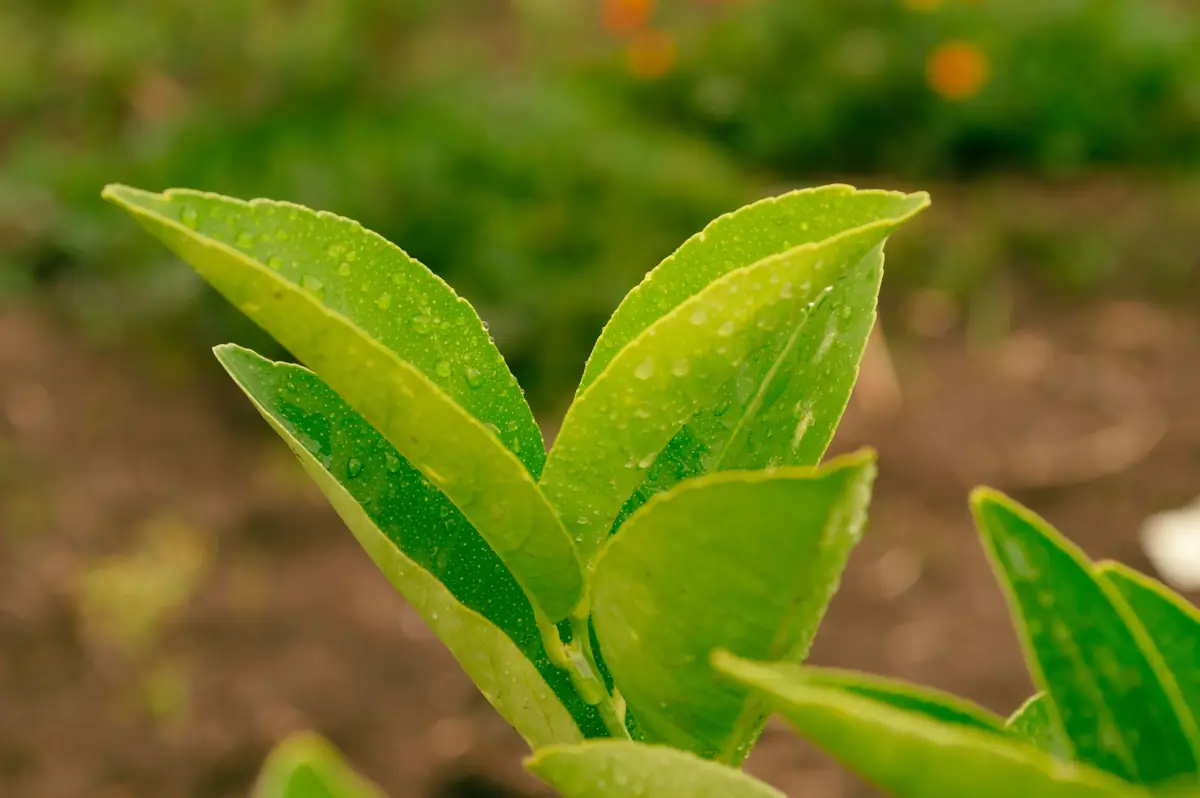
Almost every yard in this valley has citrus in it. A lemon by the wall, a grapefruit that came with the house, a couple of oranges along the side where nothing else would grow. And almost every summer somebody looks at the new growth, sees silvery squiggles winding through the young leaves, and starts pricing sprays.
Those squiggles are citrus leafminer. The useful thing to know about them is that the recommended treatment for a backyard tree is to do nothing.
What the squiggles are
The larva of a very small moth feeds between the upper and lower surfaces of a young leaf, leaving a shallow tunnel behind it. The leaf often curls and looks distorted where the mine runs, and the silvery trail is the empty tunnel, not the insect.
It only goes after young, flushing leaves. Mature hardened foliage isn't suitable, which is why a tree can look badly hit on its new growth and perfectly normal everywhere else.
It's also a relatively recent arrival. Citrus leafminer wasn't found in California until 2000, and the first detection was in Imperial County. That's the next county over, which puts the Coachella Valley about as close to the front door as anywhere in the state. Ours were among the first citrus trees in California to meet it.
Why University of California says leave it
This is the part that surprises people, so it's worth being exact about it.
The UC guidance is that the best course of action is to leave the unsightly leaf damage alone and let the natural enemies of the citrus leafminer feed on and parasitize the larvae in the mines, rather than trying to control this pest with insecticides. In areas where the invasion has been established longer, damage severity decreases as natural enemies parasitize or consume the leafminers.
Two things follow from that.
The first is that the larva is inside the leaf. A contact spray lands on the outside of a tunnel, which is a fairly good description of doing nothing while paying for it.
The second is the same trap we wrote about with whitefly. A broad spray kills the tiny parasitic wasps that are already working the mines for free, and those wasps rebuild their numbers more slowly than the pest does. You buy a tidier September and a worse next spring.
There's also a mistake specific to this pest. People see the damage and prune off the affected new growth. That removes the leaves the tree just spent energy making, and it triggers another flush, which is exactly the tender young foliage the next generation of moths is looking for. Pruning to fix leafminer feeds leafminer.
What is actually worth doing on desert citrus
Deal with the ants. This is the highest-value thing on the list and it has nothing to do with leafminer. Ants, dust and a dense canopy all reduce the effectiveness of natural enemies, and UC singles out the Argentine ant in Southern California for disrupting the parasites of red scale. Ants farm scale and other sap feeders for honeydew and drive off the insects that would eat them. A line of ants up the trunk means your free pest control has been evicted.
If you look at one thing on a citrus tree in La Quinta or Indio, look at the trunk for ants. It explains more sticky-leaf and scale problems than anything else.
Watch the trunk for sun. Citrus bark burns here, particularly on a young tree or one that's been opened up. Desert growers use particle films such as kaolin clay on citrus partly for sun protection, which tells you how real the exposure is. In a home yard the equivalent is not stripping the interior of the tree and not leaving the southwest side of the trunk bare. Sunburned citrus bark is also the entry point for other problems, including the sooty canker that turns up on citrus and mulberry across the valley.
Time your pruning. Citrus doesn't need much, and heavy summer pruning in Palm Desert or Rancho Mirage does two bad things at once. It exposes bark in the worst month, and it pushes the tender flush that leafminer wants.
Keep the dust down where you can. Dust interferes with the small beneficial insects, and bare decomposed granite right up to the trunk is a hard place for them to work. Irrigated ground cover nearby gives them somewhere to live.
What does deserve a call to a tree service
Leafminer on a mature backyard tree is cosmetic. These are not.
Sticky leaves with black coating, plus ants, means a sap feeder is running unchecked. That's scale, whitefly or aphids, and telling them apart decides the response. Whiteflies fly when disturbed, scale never moves at any stage and scrapes off with a fingernail.
Sudden branch death with the dead leaves still hanging on, and bark that lifts to show black powder underneath, is sooty canker rather than an insect at all.
Gumming or oozing at the base of the trunk is a different family of problem again and it's worth looking at properly rather than treating from a search result.
And a tree that's declining across the whole canopy, evenly, usually isn't a pest story. In this valley it's more often roots, water or alkaline soil locking up nutrients. Which of those it is changes what you do by a lot, and that separation is the everyday work of an arborist.
The short version
Squiggly lines in new citrus leaves in a Coachella Valley summer are normal, they're cosmetic on an established tree, and the recommended response from UC is to leave them and let the parasites work. Spend your attention on the ants, the sun on the trunk, and the water.
If someone has quoted you for a spray program on a backyard citrus tree, it's worth asking which pest it targets, where that pest is when the spray lands, and what it does to the wasps already working the tree.
We're on Highway 111 in La Quinta and we look at trees from Palm Springs and Cathedral City through Indian Wells, Bermuda Dunes and Indio. If you want to know whether what's on your citrus is worth treating, that's a short visit and usually a short answer. The Coachella Valley office can get a tree doctor out to you. Most citrus calls end as insect and pest treatment only where it helps, or as a nutrient deficiency treatment, because alkaline desert soil locks up what the tree needs even when it is present in the ground.