
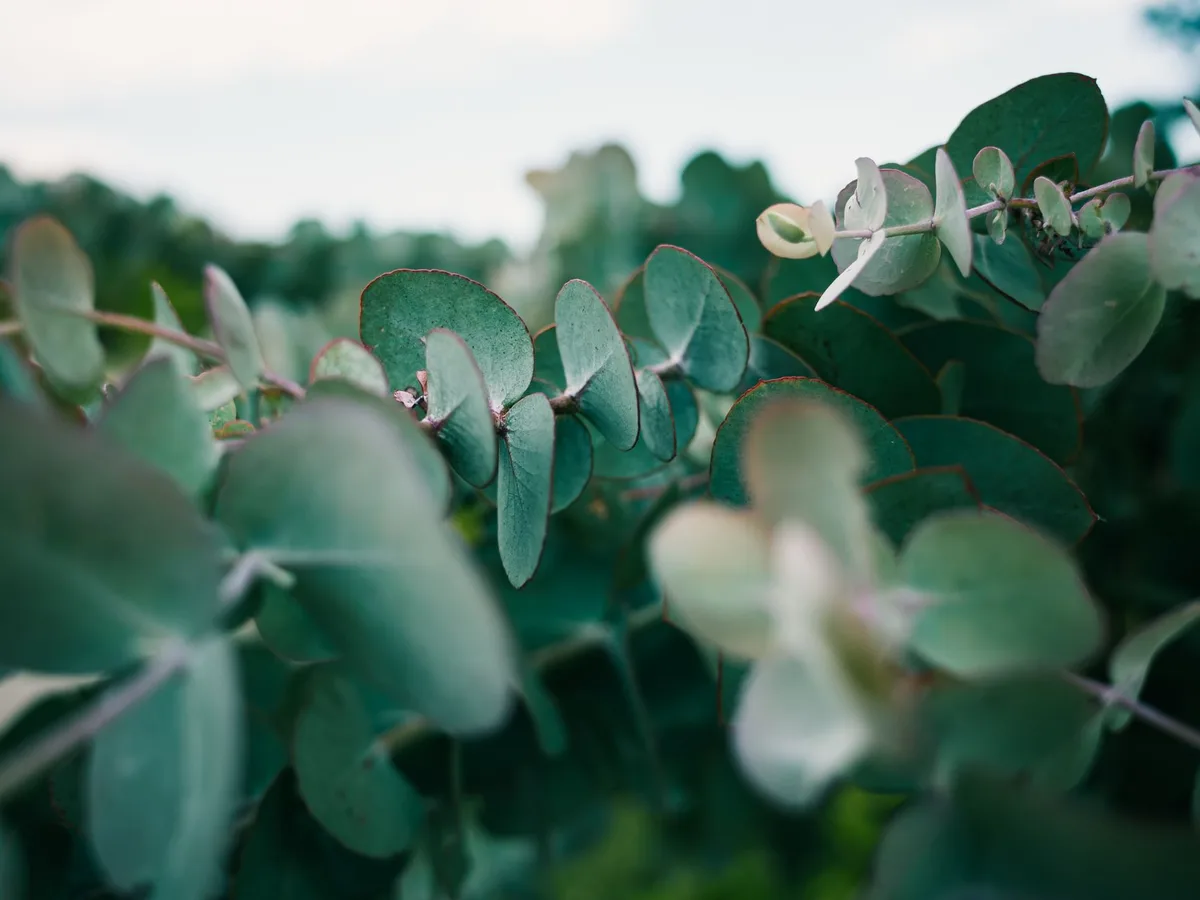
The eucalyptus has been getting chewed. Every leaf you can reach has semicircular bites taken out of the edges, some are down to nothing but the middle vein, and the damage is clearly getting worse week by week. You've looked the tree over twice in daylight and there is no insect on it anywhere.
You're not missing it. It isn't there during the day.
A beetle that works the night shift
The eucalyptus tortoise beetle came here from Australia and it's been on the valley floor for a while. There are records from Palm Springs going back to 2009, from Palm Desert in 2017, and from Indio this year, so this is not a coastal problem that hasn't arrived.
UC's description of its habits explains the whole frustration. Adults and larvae hide under loose bark during the day and feed mainly at night. On top of that they may be concentrated high in the tree, so damage can be hard to trace. The advice for finding them is to search beneath loose bark, not to search the leaves.
Which means the sign you're reading is the only sign you're going to get. UC says it outright, that notched leaves are usually the only obvious sign of infestation.
What to look for, and where
If you want to confirm it rather than assume, there are three things to find and none of them are on the foliage.
The adult is rounded and hemispherical, dark brown with blackish mottling, about a quarter to three eighths of an inch long, and it genuinely looks like an oversized lady beetle. People who find one assume they've found something helpful, which is an easy mistake to make.
The larvae look like small caterpillars, dark green to reddish brown with a black head, but they have no prolegs along the abdomen. If you're squinting at something caterpillar-shaped on a eucalyptus and the belly is bare of little legs, that's this.
The eggs are the giveaway, because they're laid in rows. Females put down five to forty or more side by side, on leaves or under loose bark, pinkish or light brown at first and darkening later. A tight row of eggs tucked under a flap of bark is a diagnosis.
So the search is a flashlight after dark, or a careful look under the loose bark on the trunk and the big limbs. A eucalyptus in Cathedral City that's been shedding bark for years has a lot of hiding places.
What the chewing costs the tree
Adults and larvae chew semicircular holes or irregular notches along edges of eucalyptus leaves, and in a bad year they can strip most of a leaf and leave only the midvein. They sometimes work on new terminal growth too, which is the part that stings, because that's the tree's growth for the season.
A mature, well-watered eucalyptus takes a season of this and carries on. The trees that get hurt are the ones that were already short of water, because then the beetle is removing canopy from a tree that couldn't afford the canopy it had.
There are several generations a year from late winter through fall, and in warm weather a beetle goes from egg to adult in about five weeks. In our climate that adds up to a long season with no real pause.
The species question
Not every eucalyptus is equally interesting to it. UC is careful to say host preferences are not well documented, but its susceptibility table puts flooded gum and river red gum on the more susceptible side, and red flowering gum, spotted gum and silver dollar gum among the least susceptible.
That matters if you're replacing a tree rather than treating one. If you don't know which eucalyptus you have, the notching pattern reads the same on all of them, and identifying the tree is a reasonable first step before anyone decides what to do about the insect.
What UC actually recommends, and the timing is now
The management list for this beetle is mostly about the tree rather than the insect, and two items on it are worth acting on in the next few weeks.
The first is pruning timing. UC says to prune in December or January if necessary. That's a narrow window and it's about to open, so if a eucalyptus in La Quinta needs work, this is the part of the year to do it rather than in the heat.
The second surprises people. Do not fertilize the tree. Feeding a chewed eucalyptus pushes out exactly the soft new growth the beetle prefers, so the instinct to help makes the tree more attractive.
Water is the one you can get wrong in both directions. UC's advice is to deep-water drought-stressed trees with drip hoses and to avoid sprinklers and frequent shallow watering. In this valley the frequent-and-shallow mistake is everywhere, and a tree can be genuinely dry while the top of the soil looks damp. That whole trap is in the difference between a thirsty tree and a drowning one, and the test in it works on eucalyptus as well as anything else.
On spraying, UC's position is short. Use pesticides rarely and always as a last resort, and broad-spectrum foliar sprays are not recommended in landscapes. There is a soil-applied systemic option for serious cases, timed late winter to early spring, which is a decision to make with somebody who has looked at the tree.
While you're under that bark
Lifting loose bark on a eucalyptus is worth doing for a second reason. Damaged or worn bark is the entry point for sooty canker and for flatheaded borers, and both of those get blamed for killing trees they only moved into. If what you find underneath is black powder rather than beetles, that's a different problem and it's described in what black powder under lifting bark means.
What we do on a call like this
We read the damage pattern first, then go looking in the places the insect actually is, which is usually bark rather than foliage. Then we look at the tree's water and its history, because the question that decides the outcome isn't how many beetles there are, it's whether this tree had the reserves to spare. Working a diagnosis means finding the first cause rather than the loudest symptom.
Plenty of these calls end with us saying the tree will be fine and the right move is to fix the irrigation and wait. That's a real answer, not a brush-off.
When to call
Call at a normal pace if eucalyptus leaves are notched along the edges and you can't find what's doing it, if the damage is spreading through the canopy over several weeks, or if you want to know which eucalyptus you've got before deciding anything.
Call sooner if whole leaves are being reduced to the midvein, if new growth at the tips is being taken as fast as it appears, or if a tree in that condition is also thinning out and dropping limbs.
We're on Highway 111 in La Quinta and we cover the valley from Palm Springs and Cathedral City through Indio and Coachella. If you want somebody to find what's eating that tree and say whether it matters, that's a straightforward tree doctor visit from the Coachella Valley office.