
Here's the call we take more than any other. A tree looks bad. The leaves are wilting, some are yellowing, and the whole thing has a droopy, tired look. The owner did the obvious thing and watered it more. Three weeks later it's worse.
That sequence is so common it's almost a diagnosis on its own. A tree that gets worse after you water it more is usually telling you the water was never the shortage.
Too much water and too little water look the same from ten feet away
Both produce wilting. Both produce yellowing. Both make a canopy look thin and sad. If you're standing on the driveway looking up, there's no reliable way to tell them apart, and that's the whole problem, because the two situations call for opposite responses.
The University of Arizona's guidance for desert trees and shrubs splits them on details you can actually check, and the most useful one isn't about the leaves at all. It's about which leaves.
Which leaves go first is the tell
A tree that's short of water gives up its oldest leaves first. The interior and lower foliage yellows or browns and drops, leaves wilt and curl, and the soil is dry when you dig down. The tree is shedding what it can't afford to keep.
A tree that's getting too much does the opposite. The new growth goes first. Young leaves turn light green or yellow, young shoots wilt while older leaves stay green, and here's the strange one, the leaves can be green and brittle at the same time. The soil stays damp between waterings. In bad cases you'll find algae on the surface or mushrooms coming up near the base.
Dig down six inches next to the tree, away from the trunk, the day before you'd normally water. If it's damp down there, the tree isn't thirsty, whatever the canopy looks like.
The lawn is usually the reason
Turf and trees want opposite things and can't both be right on one timer. Grass roots live in the top six to twelve inches and want a short soak often. Tree roots want to be eighteen to thirty-six inches down and want a long soak rarely. Put a tree in a lawn and it gets the lawn's schedule, so its roots stay up in the wet few inches where the water is.
That works until the first serious heat. Then the tree has a full-size canopy sitting on a shallow, lawn-shaped root system, and it can't keep up.
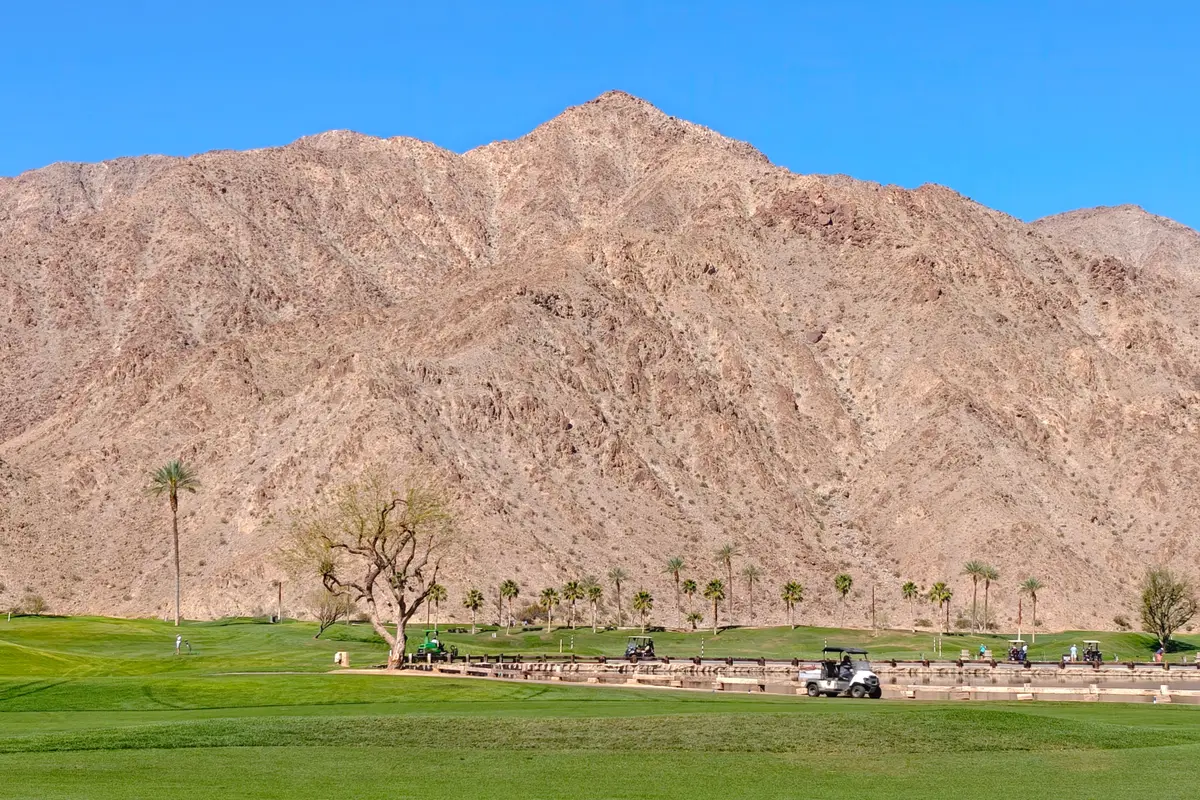
This is why we spend so much time on this in the country club and association neighborhoods. In Palm Desert especially, where fairway frontages and condominium common areas put mature trees in irrigated turf as a matter of course, the tree and the grass have been on the same valve for twenty years and nobody has ever separated them. The same pattern runs through the club landscapes in La Quinta, and it's worth more attention in Indian Wells than almost anywhere, because a thirty-year-old specimen there can't be bought back.
Arizona's extension guidance is blunter about it than most people expect. Desert trees, palo verde included, aren't recommended in turf at all, even the species that tolerate it. If you already have one there, the fix isn't to remove the lawn. It's to water the tree separately, on its own schedule, out where its roots actually are.
Where the water lands decides whether the tree stays standing
This is the part that surprises people, and it's the reason a healthy-looking tree comes down in a summer wind.
Most trees across the Coachella Valley were planted with one or two drip emitters at the trunk. That's correct for the first year and wrong forever after. Roots grow where the water is, so if the water never moves outward, neither do they. You end up with a full-size canopy anchored by a root plate the size of the original planting hole.
Arizona's guidance on this is worth quoting almost directly: placing emitters close to the trunk makes roots develop only there, and moving them out to the dripline and beyond builds the root system that gives the tree stability and reduces toppling. The active absorbing roots are at the dripline and past it, not against the trunk.
Two practical points follow. Don't move the original emitters when you expand the system, because there are established roots there now. Add new ones outward instead. And most roots spread one and a half to four times as wide as the canopy, so "out to the dripline" is a starting point, not the edge.
When watering more actually makes it worse
There's a specific trap here and it catches careful, attentive owners more than neglectful ones.
Phytophthora root and crown rot lives in wet soil and needs remarkably little of it. UC's integrated pest management program notes these diseases can develop in as little as four to eight hours of soil saturation. And the critical detail, in their words, is that the leaves of an affected plant appear drought stressed.
So the tree looks thirsty. You water it. The soil stays saturated longer. The disease gets what it needs. The tree looks thirstier. It's a loop, and the water bill goes up the whole way through.
Arizona's extension people give a clean test for it: when you apply water to solve the problem and the symptoms don't go away, that's an important clue that water stress alone isn't what's causing it. If you've genuinely increased irrigation and nothing improved in a few weeks, stop increasing it. The answer is somewhere else.
Sorting that out is ordinary work for an arborist who looks at the roots and the soil before the leaves, and it's usually a cheaper visit than a season of guessing. Palms are their own case and fail on a different timetable, which is why most of the palm diseases people read about online turn out to be irrelevant here.
Before you touch the timer
Four things, in order, and none of them cost anything:
- Dig down six inches at the dripline the day before the next scheduled watering. Damp or dry?
- Look at which leaves are failing. New growth, or old?
- Find your emitters. Are they at the trunk or out at the dripline?
- Check whether the tree shares a valve with turf. If it does, that's your first change.
If the answers point at too much water, the correction is usually longer and less often rather than more often. Deep, infrequent irrigation builds deep roots that ride out heat. Light, frequent irrigation builds shallow, weak ones that can't.
And if you're standing in an older neighborhood in Palm Springs, or on one of the lawn-era tract streets in Indio or Cathedral City, looking at a tree that's been on the same lawn valve since it was planted, the tree may be fine and the schedule may be the entire problem. That's a good outcome. It's also one you only find by looking underground, which is what a diagnosis is for.
When it comes to your trees, you deserve the best.