
There's an insect about ninety miles southwest of here that has killed more than twenty thousand palms since it got established, and the palm it prefers is the one standing in the front yards of half the older neighborhoods in this valley.
It isn't established here. Adults have been trapped here, which is a different and more useful sentence, and it's worth knowing what you'd be looking at if one of them found your palm.
Where this actually stands, in order
The South American palm weevil got a foothold in San Diego County around 2014. UC puts its spread plainly, saying it has spread to at least neighboring San Diego County where it is killing Canary Island date palms. The count down there is past twenty thousand trees.
Up here the honest status is narrower. CDFA has trapped adults in the Coachella Valley, but an established infestation has not been confirmed and the insect has not been found in our commercial date palms. So the carrier shows up in traps and the damage doesn't, which is the gap worth protecting.
Two things make people take that gap seriously. The weevil is a serious flier, and a female has been measured covering more than a hundred kilometers in a single day. And the valley has a date industry worth a few hundred million dollars sitting between Indio, Coachella and Mecca, which is a lot of host material in one place.
Being honest about the status matters because the alarming version gets people cutting down healthy palms. Nothing in this article says your palm has this.
This one kills from the top down
Here's the part that separates it from what we usually find, and it's the reason to learn the signs now rather than later.
We already have a big native beetle in our palms. The giant palm borer leaves half-inch holes in the trunk, and those holes are exits from an insect that only moves into palms that were already dying. We wrote about that in what those holes in your palm trunk actually mean, and the short version there was that the beetle is the ending rather than the cause.
The palm weevil is the opposite kind of problem. The larvae bore into the center of the palm and chew at the growing point, which is the one part of a palm that cannot be replaced. A palm has no cambium, no ring of new wood each year and one growing tip. Kill the tip and the tree is finished no matter how good the trunk looks.
So with this insect you don't read the trunk first. You read the newest leaves in the middle of the crown.
What you'd actually see
UC's list of signs is specific, and several of them are things a homeowner can check from the ground with binoculars.
The adults chew on fronds and leave a ragged appearance. Then comes dieback of the newest, central leaves, with larval mines and frass at their bases, which is the signal that matters most. Leaf tips look truncated. Tunnel openings on the trunk push out chewed material. There's a fermented odor, and people standing next to a badly infested palm have reported gnawing sounds coming from inside the trunk.
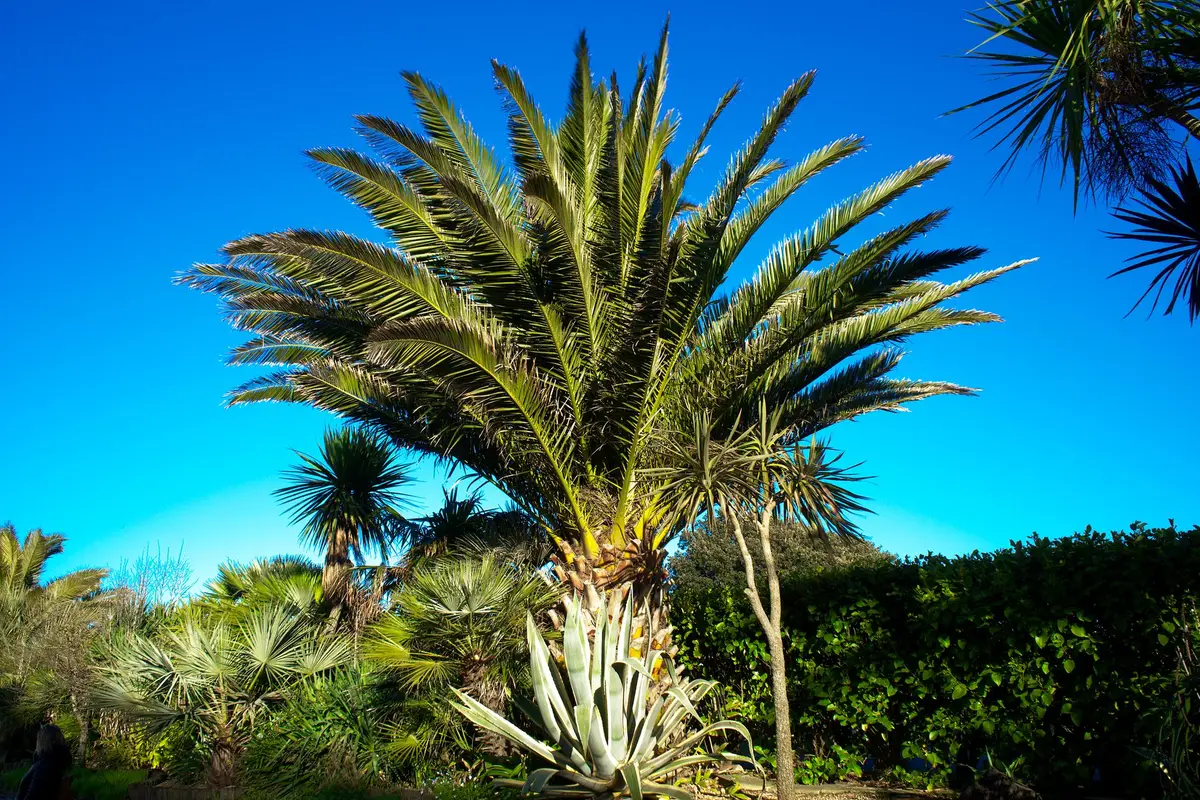
As the larvae work where the fronds attach, UC says this causes a sparse canopy of few fronds, and the trunk structure is seriously weakened. At the end, for the palm it prefers, when Canary Island date palm is heavily fed upon, the entire leaf crown may drop.
That last sentence is why this is a safety matter and not only a plant health one. A crown coming off a mature Canary Island date palm over a driveway in Rancho Mirage or an older street in Palm Springs is a serious weight landing without warning.
The adult itself is hard to miss if you see one. It's a large snout beetle about an inch and a half long, and the color runs from solid black to orange with black spots.
What it isn't
Center-leaf problems on palms have other causes, and most of them are more likely than this.
Stunted, distorted new leaves with pinkish spore masses are pink rot, which is a fungus that moves into palms that were already stressed or wounded. A palm that's thin and pale with no mines and no frass is usually water or soil, and in this valley that's the common answer. We went through that list in what's actually killing palms here, and nothing on it requires an insect.
The distinction to hold onto is mines and frass at the base of the newest leaves. Rot doesn't tunnel and drought doesn't leave sawdust.
The things that actually help
UC's recommendations for this weevil are mostly about not moving it and not feeding it, which is unglamorous and happens to be the only part a property owner controls.
Don't bring palms into California unless they're certified pest free or were inspected by agricultural officials. That one line is how most range expansions happen in the first place, and a mature palm trucked in from a nursery down south is exactly the pathway. If you're planting new, the resistant choices UC names are easy ones for us anyway, with California fan palm and European fan palm both on the list and both already suited to La Quinta and the rest of the valley.
If you think you've found one, it gets reported to the county agricultural commissioner. That's not a formality. A confirmed find in a new place is how the trapping grid gets tightened, and in Riverside County the trapping is the thing standing between the current situation and the San Diego one.
Sanitation is the other half. An infested palm gets removed and the material burned, chipped or buried deeply rather than hauled around, because a dying palm full of larvae is a nursery.
What we do on a palm like this
We look at the center of the crown before anything else, then at the spear leaf, then at where the fronds meet the trunk. We sound the trunk, check the canopy count against what that species should be carrying, and look for mines, frass and tunnel openings rather than for the insect itself. Working a diagnosis means finding the first cause rather than the loudest symptom, and on palms the first cause is usually water, soil or a pruning history.
We'll also say when the answer is that your palm is fine and the thing bothering it is something ordinary. That's the outcome in most of the palm calls we take in Cathedral City and the rest of the valley.
When to call
Call at a normal pace if a Canary Island date palm is thinning out, if the newest leaves in the center look stunted or dead while the outer fronds are still green, or if you want someone to look at a palm you're worried about before you decide anything.
Call sooner if you find sawdust-like frass at the base of the central leaves, tunnel openings on the trunk pushing out wet chewed material, a fermented smell around the crown, or a palm in that condition standing over a driveway, a walkway or a roof.
We're on Highway 111 in La Quinta and we cover the valley from Palm Springs and Cathedral City through Indio and Coachella. If you want somebody to tell you what's in the top of that palm, that's a straightforward tree doctor visit from the Coachella Valley office.