
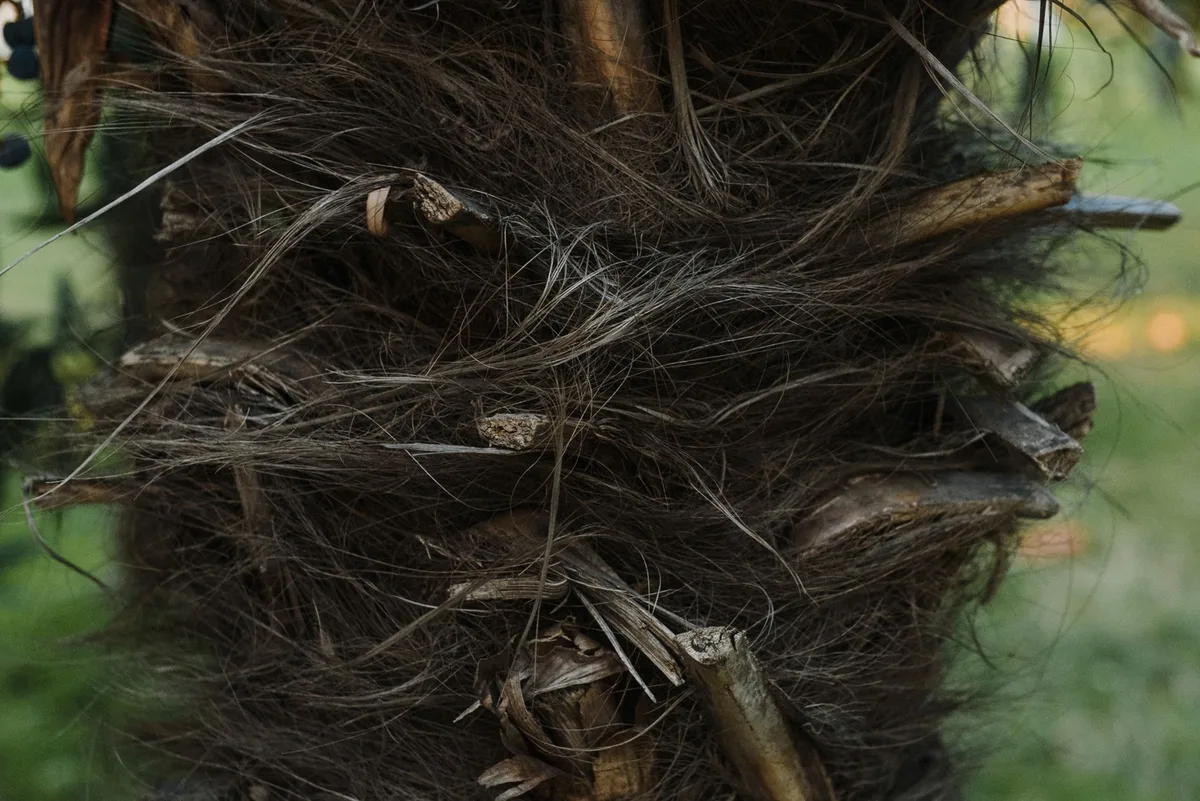
You're walking past the palm and something catches your eye on the trunk. A round hole, clean-edged, about the width of your little finger. Then another one a foot higher. The fronds up top have been going yellow for a while and you'd put that down to the heat.
Those holes are the giant palm borer. And the thing worth knowing before you do anything is that the beetle didn't start this.
This beetle belongs to us
Most tree pests we deal with got here from somewhere else. This one didn't. Dinapate wrightii is a Colorado Desert native, and the collection record reads like a drive down Highway 111. Specimens have come out of Palm Springs, Palm Desert, Rancho Mirage, Thousand Palms, Desert Hot Springs and Thermal, going back to 1922 and running through a CDFA sample taken in Palm Desert in 1989 right up to recent years.
It's also the largest beetle you're ever likely to find in your yard. The University of California describes the adults as blackish to dark reddish-brown and up to two inches long. People bring them to us in jars.
Two palms carry it: the California fan palm and the date palm. Between those two you've covered most of what's planted here, which is why this comes up more in the Coachella Valley than anywhere else in the state.
The hole is an exit, not an entrance
This is the part that changes what you should do next.
The hole you're looking at wasn't made by a beetle going in. It was made by an adult coming out. UC's description is that adults emerge leaving holes in trunks about half an inch in diameter, and before that emergence the larva was inside the trunk feeding.
For how long? UC puts it at three to nine years.
Read that again, because it reframes the whole thing. By the time you noticed the first hole, something had been living in that trunk since before you repainted the house. The palm has been hosting this quietly for years, and the hole is the announcement at the end, not the beginning.
So treating the hole is treating a scar. Whatever you spray on the outside of that trunk today reaches nothing.
The sentence that tells you what's actually wrong
UC's page on this insect has one line that does more diagnostic work than anything else written about it. The giant palm borer is a secondary pest. It attacks hosts that are dead, dying, or severely stressed.
Secondary means the beetle is a consequence. A healthy palm, watered properly and not mangled by pruning, isn't what this insect looks for. So when we find exit holes on a palm in Palm Desert, the useful question isn't how to kill the beetle. It's what was wrong with the palm three to nine years ago that made it available.
That's a different job, and it's the one worth paying for. Finding the original stress is the difference between losing this palm and losing the next three as well, because whatever weakened it is usually still happening in that yard.
What puts a palm in that condition here
Usually it's water, and usually it's the wrong kind of wrong. A palm on a lawn schedule gets frequent shallow water that never reaches the root zone, so it's drought stressed while standing in wet soil. We wrote about what's actually killing palms in this valley and most of it comes back to this.
The other common one is pruning. Cutting green fronds off a palm takes away the food factory, and a palm has no way to make that up quickly. There's no cambium under the bark of a palm, no ring of new wood each year, no compartmentalizing a wound the way an oak does. Every cut is permanent and every removed frond is a withdrawal from an account the palm can't top up fast. A palm that's been over-trimmed for a decade is exactly the kind of stressed host this beetle is described as attacking.
Then there are the honest ones. Transplant shock, a trunk wound from a mower or a truck, a hot wall reflecting onto one side, or simply a palm at the end of its life. Those happen, and a palm that's genuinely finished is finished. Knowing which one you've got is the point.
There's no spray, and that's not the bad news it sounds like
UC is direct about this. No control other than good preventive care of palms is known. There's no rescue treatment, no trunk injection, no soil drench that reaches a larva nine feet up inside a trunk.
Everybody's first reaction to that is that it means nothing can be done, and it doesn't. It means the work is in a different place. Good growing conditions and proper cultural care is UC's recommendation, and the second half of it matters too: dead palms are where the next generation comes from, so a dead or effectively dead palm standing in the yard is a source, not just an eyesore.
If you have a row of palms and one is riddled, the question for the rest of the row is what they're sitting in and how they're being watered, not what to spray on them.
What an arborist actually does with a palm like this
Looking at a palm with exit holes is partly about the palm and partly about what's under it.
We sound the trunk, look at where the holes sit and how many there are, look at the crown for how much live frond there is against how much has gone, and check the spear at the center, because a palm that's lost its growing point is not coming back whatever the trunk looks like. Then we go to the ground and the irrigation, because that's where the answer usually is. The diagnosis process is the same one we use on any tree: find the first cause, not the last symptom.
The honest outcome is sometimes that the palm is done. A hollowed trunk over a driveway in La Quinta is a structural question and not a plant health one anymore, and we'll say so. But we'd rather say it after looking at the tree than have you take it out on the strength of a hole in the bark.
When to call
Call at a normal pace if you're seeing round holes about half an inch across in a palm trunk, if fronds are yellowing from the bottom up faster than usual, or if you've got several palms and one has clearly gone downhill ahead of the others.
Call sooner if the trunk sounds hollow when you knock on it, if there's a lean that wasn't there before, or if a palm in that condition is standing over a driveway, a walkway or a roof.
We're on Highway 111 in La Quinta and we cover the valley from Palm Springs and Cathedral City through Indio and Coachella. If you want somebody to tell you whether the beetle is the story or just the ending, that's a straightforward tree doctor visit, and it's a lot cheaper than replacing a mature palm you didn't have to lose.