

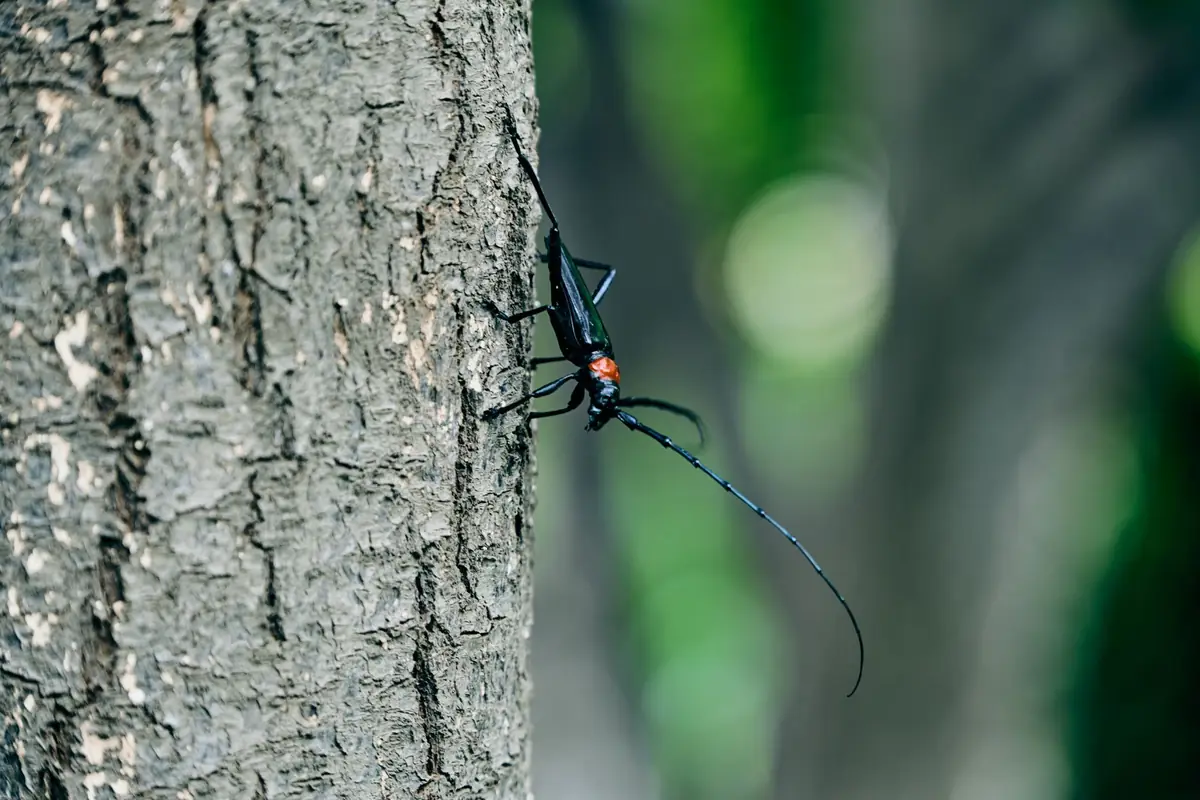
It's a July evening, the porch light is on, and something hits the window hard enough that you stand up. Then you see it on the patio. A beetle the length of your hand, black-brown, long antennae, walking like it owns the place.
Every summer we get calls about this in the week it starts, from Palm Springs to Indio, and the question is always the same. Is that thing killing my tree?
The honest answer has three parts, and only one of them is worrying.
What it is
It's the palo verde root borer, Derobrachus hovorei, and it's native. Not an invasive, not new, not something that arrived on a shipment. It belongs to the Sonoran Desert, which is the desert we live in.
Adults reach about three and a half inches. They come out in summer, around the monsoon, and they're mostly flying at night, which is why they find your porch light and not your neighbor's dark yard.
Here's the part people are relieved to hear. The adult doesn't eat. It has about a month to live, it runs on what it stored as a larva, and its entire job is to find a mate. It isn't chewing your tree, it can't bite you in any way that matters, and it will be gone by August.
There's a look-alike, and it changes the answer
Not every giant beetle on a Rancho Mirage patio is a palo verde borer. The California root borer, Prionus californicus, is a similar size and turns up in the same season.
The tell is the antennae. On the California root borer they're distinctly toothed, like a saw blade or a comb. On the palo verde borer they're segmented but not toothed. It takes ten seconds with a flashlight and it matters, because the two use different host plants and finding one tells you something different about what's underground.
If you're going to send us a photo of one, get the antennae in the shot.
The part that's actually about your tree
The adult is harmless. The larva is the reason to pay attention.
The female bores down about a foot into the soil to lay eggs, and the larvae then feed on roots for up to three years before they emerge. So an adult beetle in your yard in July isn't news about this month. It's news about something that has been going on in a root system near you since roughly 2023.
That's a long, quiet head start, and it's why the beetle is easy to misread. People see the adult, panic, and want something sprayed. But by the time you're looking at the adult, that individual is finished with your tree. There's nothing left to protect it from.
It also means the honest framing is the reverse of what people assume. The beetle isn't the beginning of a problem. It's the visible end of one that's been running underground for years, in a palo verde or mesquite that's probably older than the house.
What we don't know, said plainly
You'll read confident claims online in both directions. That the beetle kills healthy trees. That it only ever attacks trees already dying. The extension literature we trust doesn't actually settle it, and we're not going to pretend otherwise to make a tidier article.
What's documented is this. The larvae feed in roots for years. Heavy feeding removes root tissue a tree needs. Trees that are already short of water or root space have less margin to lose. That's enough to act on without inventing the rest.
It's the same discipline we apply to the leaf pests on a ficus hedge, where three different insects get treated as one because nobody looked closely. Saying "we don't know" where it's true is part of the job, and an arborist who won't say it is guessing at your expense.
So what do you actually do
Nothing, to the adult. Move it off the patio with a dustpan if it bothers you. There is no useful spray, and there is nothing to spray it on, because the damage is done by larvae a foot underground across a root system you can't reach.
What's worth doing is looking at the tree, because the beetle is a prompt rather than a diagnosis.
Check the root zone. Most valley palo verdes and mesquites are watered as if they were shrubs, on emitters clustered near the trunk. That builds a small, shallow root plate on a tree that's meant to root wide, and a small root plate has no room to lose any.
Look at the base. A tree that's leaning slightly, or that has soil lifting on one side, is telling you about roots. In an Indian Wells or La Quinta yard where a mature palo verde sits close to a driveway or a pool deck, that's worth taking seriously before wind season.
Note how many you're seeing. One beetle in July is a normal Coachella Valley summer. A dozen coming out of the same corner of the yard, several years running, is a pattern worth a look.
Don't remove a tree over a beetle. This is the one that costs people money. A healthy palo verde with a beetle on the patio is not a hazard, and taking it down in La Quinta or Bermuda Dunes buys you a decade of waiting for shade you already had.
When to call an arborist in the Coachella Valley
Call if a mature palo verde or mesquite is thinning at the top, leaning, or dropping limbs, whether or not you've seen a beetle. Those are root and structure questions and they're worth answering before the wind through the pass answers them for you.
Call also if someone has quoted you for treatment on a palo verde borer, because we'd want to know what exactly is being treated and where.
And if you just want to know what landed on your window, send a photo with the antennae visible. That's a two-minute answer, it costs you nothing, and it's a better use of a tree doctor than a removal quote.
We work out of La Quinta and cover the valley end to end, Palm Desert, Thermal, Cathedral City, all of it. The Coachella Valley office is the place to start.