
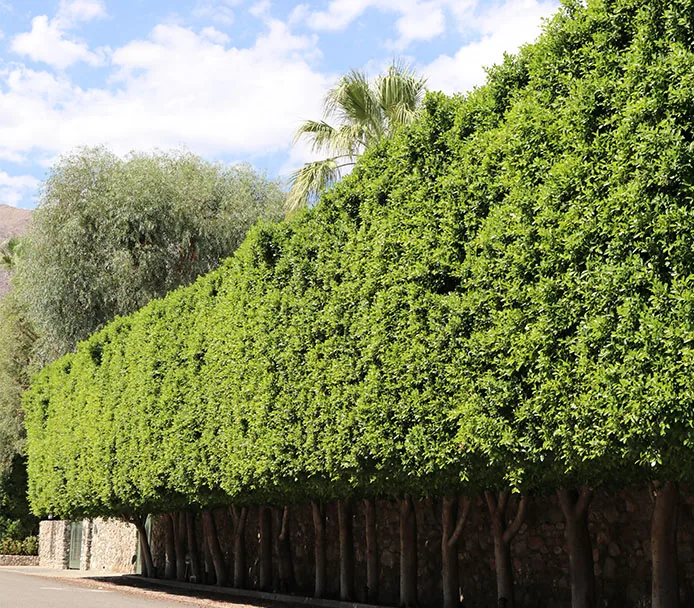
Half the privacy in the Coachella Valley is a ficus hedge. Drive through La Quinta, Indian Wells or Rancho Mirage and you'll pass a mile of it, Indian laurel fig clipped flat, running along a wall or between two properties. It handles the heat, it takes hard shearing, and it stays green when everything else is complaining.
Then one summer the leaves go strange. Some of them curl into tubes. Some fold in half. Some come out covered in hard little bumps. And because all three look roughly like "something is eating my hedge," people spray for all three the same way.
They're three different insects. Two of them arrived here fairly recently. And the useful thing to know up front is that none of them is going to kill your hedge.
Look at the shape of the leaf
You don't need to find the insect. The leaf tells you which one you have.
Rolled tightly into a narrow tube. That's the ficus leaf-rolling psyllid. UC describes the leaves as rolled lengthwise into cylinders about a sixth of an inch across. The giveaway is what color they stay. The rolled leaves go dry and brittle but they stay green, which is what separates this from everything else on the list.
It showed up in California around 2016 and UC now lists it in Los Angeles, Orange, Riverside, San Bernardino, San Diego and Ventura counties. Riverside County is us. Everything from Desert Hot Springs down through Palm Desert to Indio sits inside it, so this one is already here and it's recent enough that a lot of people have never seen it before.
Folded in half along the middle vein, with purple or reddish brown marks. That's Cuban laurel thrips. The leaf folds along the main vein and makes a permanent pod, and the folded tissue scars dark brown, reddish or purplish.
Open one up and there are small black insects inside, about a tenth of an inch long, along with paler young ones. That color is how you tell it from the psyllid. The psyllid leaves the leaf green. The thrips leaves a stain.
Hard round bumps on the leaf, on both sides. That's the ficus gall wasp. UC calls them spherical swellings or warty blisters on the lower and upper surfaces, anywhere from a twentieth to two thirds of an inch across.
Both sides is the detail worth holding on to. Plenty of things mark the top of a leaf or the underside. Bumps pushing through both faces of the same leaf is this insect.
None of these kills the hedge
This is the part that changes what you should spend.
On the gall wasp, UC's position is that tree health and survival appear not to be threatened by the galls, and that no control action is necessary to protect the plant. On the thrips, they say that apart from the appearance, these insects don't seriously harm ficus, so no control is needed if you can live with distorted leaves.
The psyllid is the one with the least known about it, since it's newest. Heavy numbers can cause early leaf drop and thin out the canopy, so a badly hit hedge can look sparse. But UC is honest that there's no research-based information on managing it yet.
So the real question isn't how to kill them. It's how much distorted foliage you're willing to look at.
Why spraying is usually the wrong move
Two reasons, and they're different for each pest.
For the psyllid, a contact spray physically can't get to the insect. It's feeding inside a rolled leaf. UC says contact insecticides may not be effective for exactly that reason. You'd be spraying the outside of a tube.
For the thrips, the systemic products that do work also harm the natural enemies. Green lacewings and minute pirate bugs are already working on your hedge for free, and UC's advice is to conserve them, control ants, and stay off broad-spectrum insecticides. Kill the predators and next year is worse, which is the same pattern we wrote about with whitefly.
What does help, and costs nothing, is cutting. Pruning out infested tips takes the current generation with them, and on a hedge you're shearing anyway that's not extra work, it's timing. UC suggests winter for the thrips.
Bag what you cut and get it off the property rather than leaving it in a pile by the gate. Same rule as any other pest you're pruning out.
If you're planting new hedge
Worth knowing before the shovel comes out. There's a cultivar of Indian laurel fig called 'Green Gem' that UC lists as resistant to Cuban laurel thrips and to weeping fig thrips.
That doesn't cover the psyllid or the gall wasp, so it isn't a magic answer. But if you're putting in a long run of new hedge and you have the choice at the nursery, it takes one of the three problems off the table permanently, for the same money.
The ficus problems that are actually worth worrying about
Since we're here. The leaf pests get all the attention because you can see them from the patio, but they're the least of it.
Sudden heavy leaf drop is usually not an insect at all. Ficus is a warm-climate plant and it reacts to cold snaps, to being moved, and to changes in watering by dumping leaves. Our winter nights run colder than people expect from a place that spends July over 110, and a hedge that thinned out after a cold week in January is telling you about January, not about bugs.
Watering is the other half of that. Most valley hedges live on drip, and a line that clogs or a timer someone changed in spring shows up in the foliage weeks later, long after anyone remembers touching it.
The last one is what's happening underground. Ficus roots go a long way and they find things, which matters more here than most places because we plant these hedges tight against block walls, driveways and pool decks. That's a longer conversation and it depends on what's near the hedge.
When it's worth having someone look
Call if the hedge is genuinely thinning rather than just looking rough, if whole sections are dying back instead of individual leaves being deformed, or if you're about to spend money spraying and want to know whether it'll do anything. Telling one leaf pest from another up close is most of what a tree doctor does.
And if someone has quoted you for treatment on a ficus hedge, ask which of the three they found. If the answer is vague, that's worth a second look before you pay for it.
We're on Highway 111 in La Quinta and we cover the whole valley. If you want someone to walk the hedge with you, that's what the Coachella Valley office is there for.