
Somebody comes out, cuts the green clumps out of the mesquite, hauls them away, and the tree looks clean. Eighteen months later the clumps are back, in the same spots, and you're paying for it again.
That isn't bad luck and it isn't a second infection. It's what happens when you cut mistletoe off instead of out.
The plant you can see is the small half
Mistletoe isn't sitting on the branch. It's plumbed into it.
The green growth outside is connected to a network inside the wood called haustoria, which push into the branch's water-conducting tissue and take water and minerals from it. That network runs further along the branch than the visible clump suggests, and it's alive whether or not anything is showing on the outside.
The University of California puts the consequence in one sentence in its guidance on mistletoe: if visible portions of mistletoe are removed, new mistletoe plants usually resprout from the haustoria.
So the crew that snapped the clumps off did remove mistletoe. They just removed the part that wasn't the problem.
The number that matters: one foot below
UC's instruction is specific, and it's the whole article if you only read one line. Remove branches at least one foot below the point of mistletoe attachment.
A foot. Not at the clump, not a couple of inches back into clean-looking wood. That distance exists because the haustoria have already spread inside the branch past anything you can see from the ground.
This is also why the job is more expensive than it looks and why the cheap version doesn't hold. Cutting a foot below attachment often means taking a whole limb rather than a tuft, and that's a structural decision about the tree, not a tidying job. On a mature mesquite in La Quinta or a palo verde in Indian Wells, deciding which limbs can come off without wrecking the shape and exposing the trunk to sun is the actual work, and it's the part an arborist is being paid for.
When you can't cut a foot below
Sometimes the attachment point is on the trunk or on a scaffold limb that can't be removed without ruining the tree. UC's alternative is to cut the mistletoe flush and wrap the site in black polyethylene to keep light off it, on the reasoning that the mistletoe will die within a couple of years without light. UC is careful to say it may be necessary to repeat the treatment.
It's slow, it looks odd on a front-yard tree in Rancho Mirage, and it doesn't always work first time. But it's honest, it's cheap, and it's better than the alternative of cutting the same clumps off forever.
For a tree that's carried so much for so long that there's nothing left to prune back to, UC's position is blunt: remove trees that are too severely infested to prune back, and replace them with less susceptible species. That's a real answer and sometimes it's the right one. It's also a decision worth a second opinion before anyone starts a saw, which is what our questions to ask before a removal are for.
Why it keeps coming back to your yard specifically
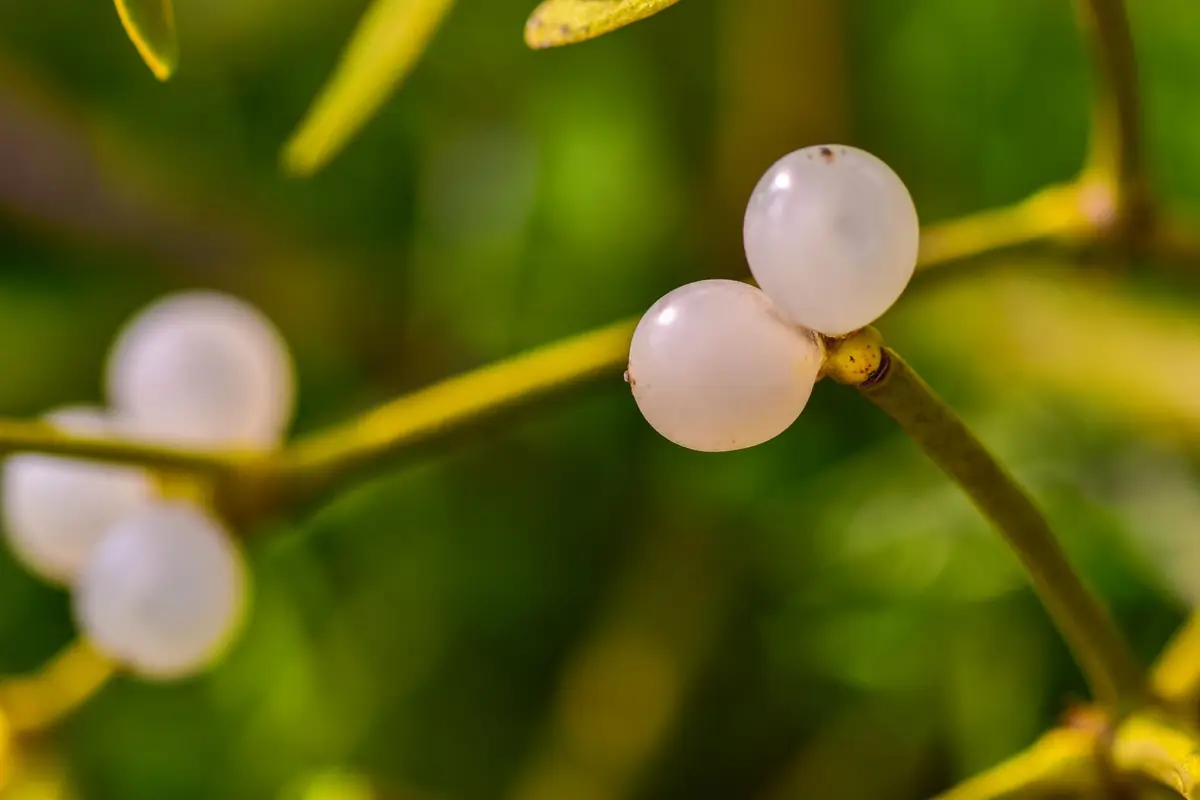
Birds spread it. UC's description is that birds feed on the berries and defecate the living seeds, which stick tightly to any branch on which they may land.
Out here that's ordinary desert ecology, not a hygiene failure. Desert mistletoe grows on the legumes we plant everywhere in this valley, mesquite, palo verde, acacia and ironwood, and the birds that eat the berries move between them. If your neighbor's mesquite in Bermuda Dunes is loaded and yours is clean, that's a matter of time rather than virtue.
Which leads to the practical point most people miss. Treating your tree once, thoroughly, is worth more than treating it lightly every year, but neither stops reinfection from next door. Expect to look at the tree annually and take out new attachments while they're small, because a young infection is a small cut and an old one is a limb.
How much harm is it actually doing
Worth being proportionate. A few clumps on a large, otherwise healthy mesquite is not an emergency, and nobody should be quoted an emergency price for it.
Where it turns serious is when the load is heavy, when the tree is already short of water, or when the infestation is concentrated on one limb, which then declines and becomes a structural risk over something you'd rather it didn't land on. Heat and drought stress do the same thing here that they do with every other pest we deal with. They shrink the tree's margin, and the pest takes the difference.
The seasonal detail worth knowing is that mistletoe is easiest to find in winter on a deciduous tree, when the host has dropped its leaves and the mistletoe hasn't. A mesquite in January in Palm Desert shows you every clump it has. That's the month to walk the tree and count, not July when the canopy hides everything.
Why this is not ordinary tree trimming
Call if you're seeing clumps for the second or third time in the same tree, if a crew has been cutting them off flush and you want to know whether that's been worth the money, or if the attachment points are on the trunk and nobody has explained what happens next.
Call sooner if one limb is carrying most of the load and that limb is over a driveway, a walkway or a roof. That's not a plant health question anymore, it's a structural one.
We're on Highway 111 in La Quinta and we work the whole valley, Palm Springs and Cathedral City through Indio and Coachella. If you want somebody to walk the tree in winter and mark what actually needs to come off, that's a straightforward job for the Coachella Valley office, and a tree doctor visit is a lot cheaper than removing a limb you didn't have to lose. Marking mistletoe is usually part of a wider tree health assessment, and preventative tree care catches new attachments while they are still a small cut rather than a lost limb.